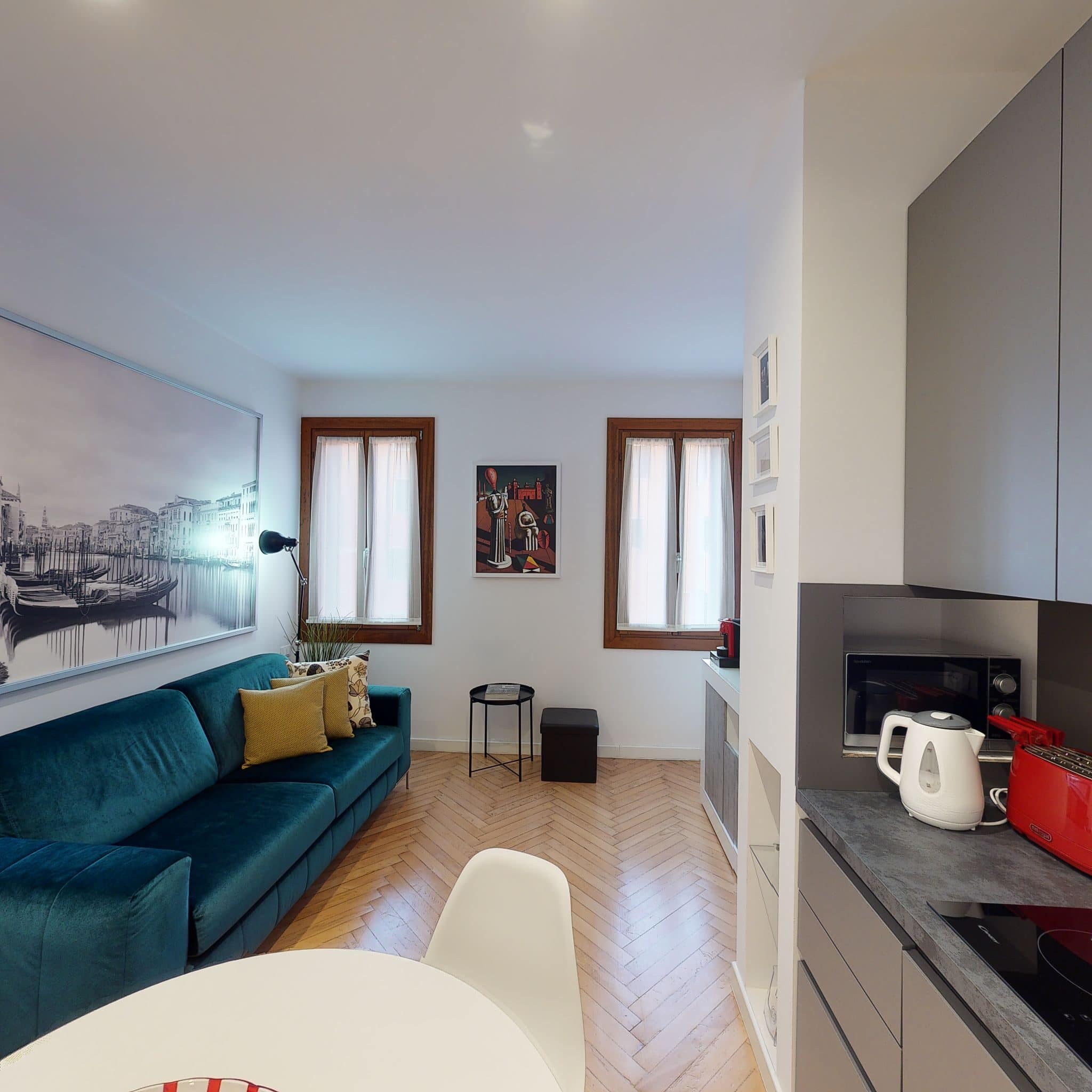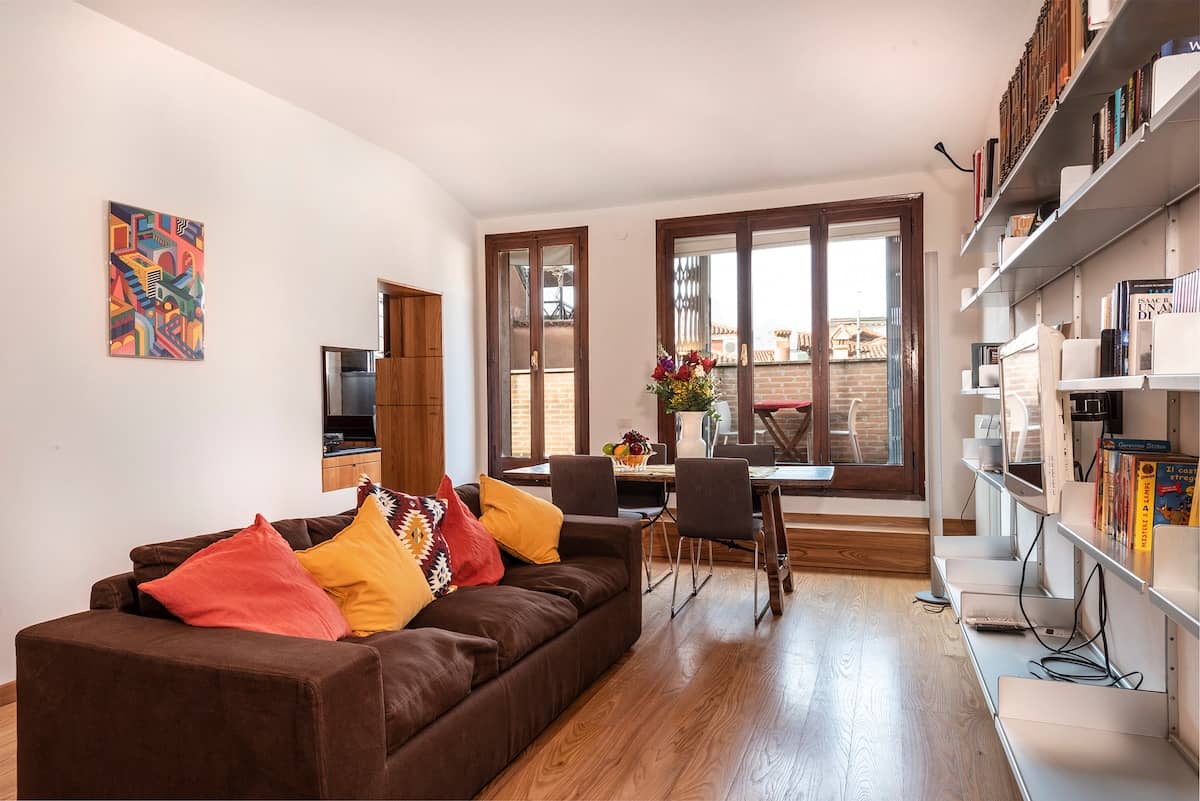
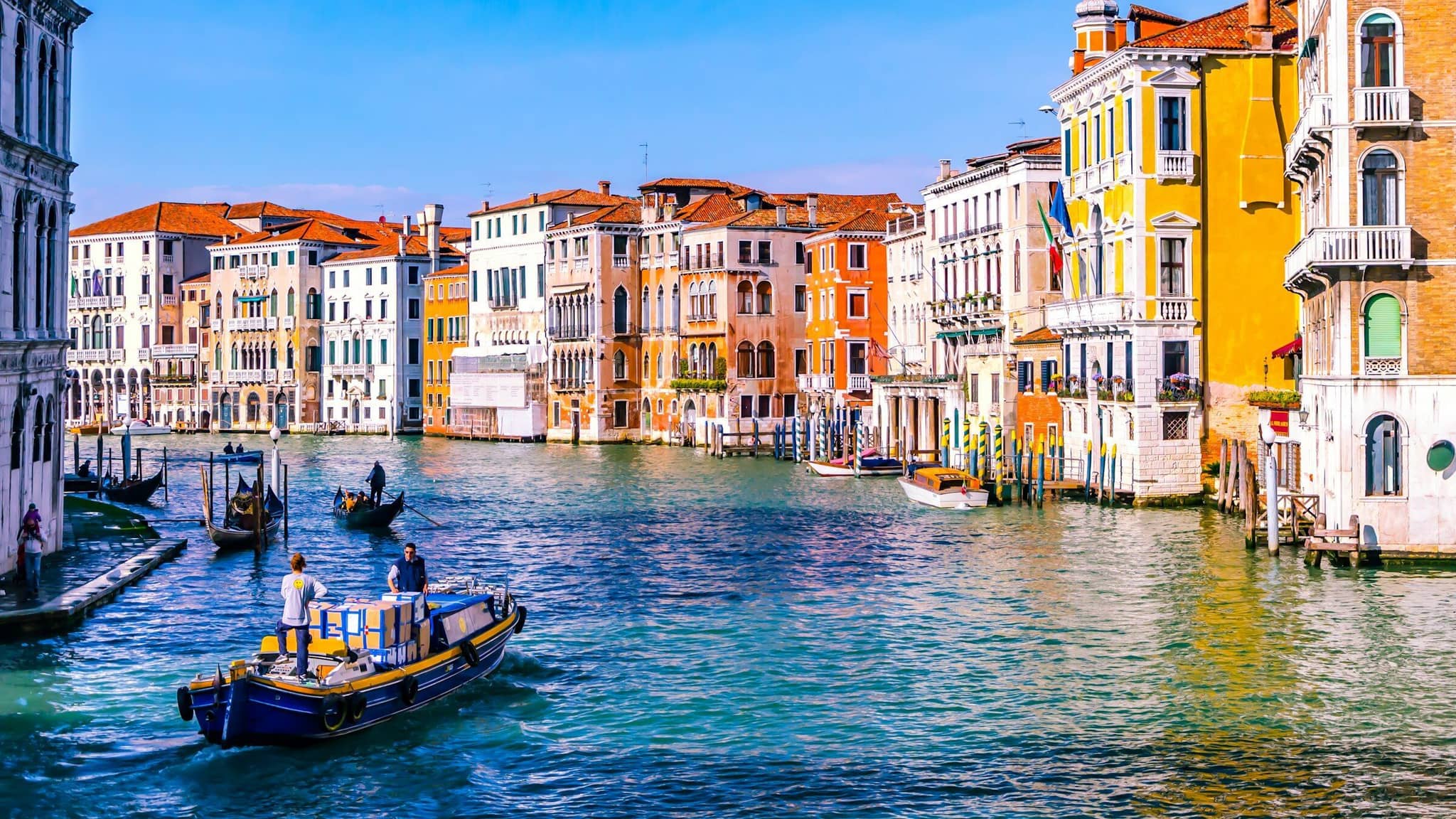
Renting an apartment in central Venice is not the same exercise as renting one in Rome, Paris, or any city with cars. Venice has no roads, no lifts in most palazzi, and no standard floor plan. This guide walks through what an apartment in Venice actually is, where to look, what to check before booking, and what to avoid. We host flats in the historic centre and have welcomed 30,000+ guests since 2014; the operational view below is what we wish every guest knew before they arrived.
Why people choose an apartment over a hotel
Venice has more hotels per square kilometre than almost any city in Europe. People still choose apartments, and the reasons cluster around three things: space, privacy, and rhythm.
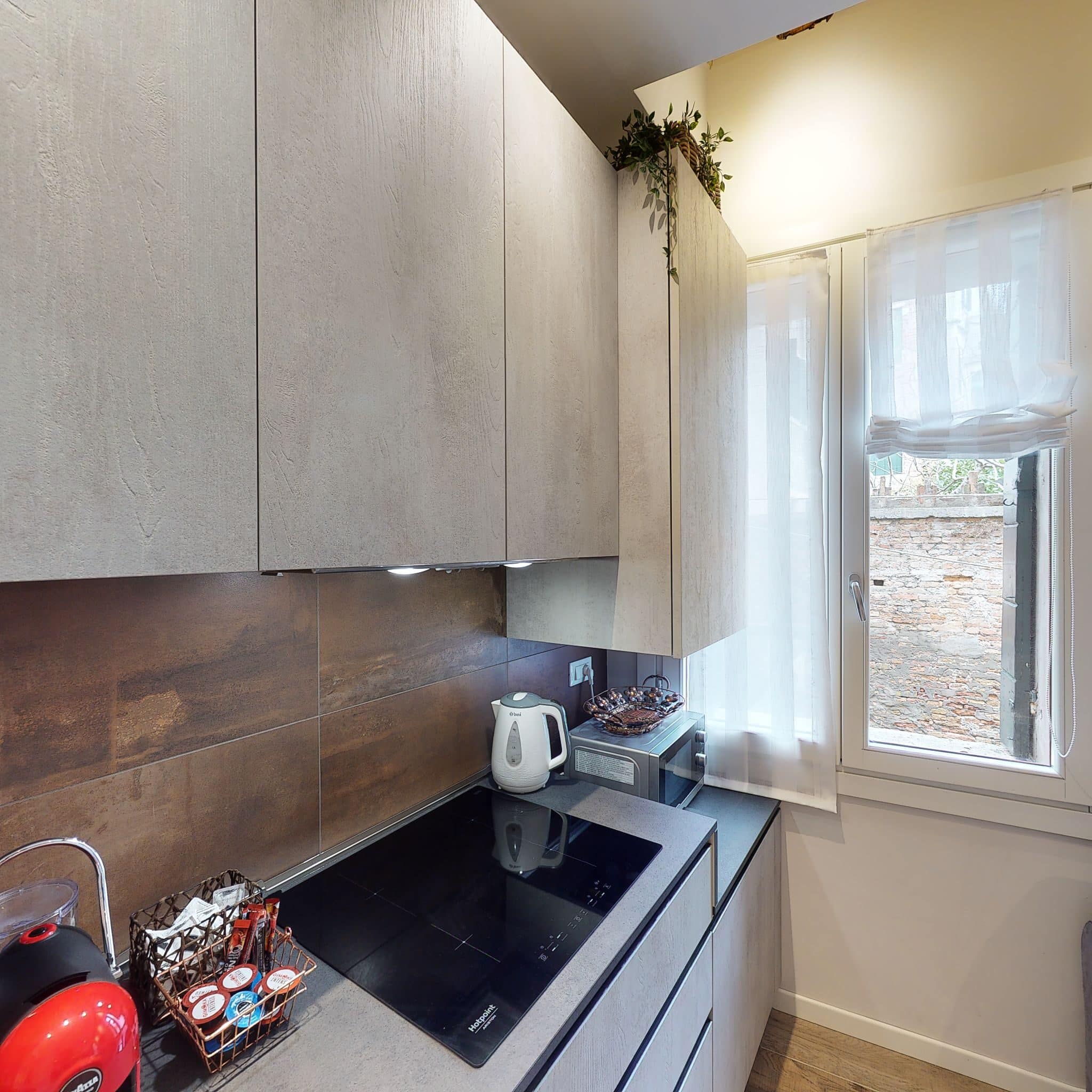
A Venetian palazzo apartment is typically 50 to 120 square metres. A hotel room in the historic centre is rarely above 25. The cost per night is comparable once you cross two guests; above three, apartments are decisively cheaper. The difference becomes structural over a four-to-seven-night stay: morning coffee in your own kitchen, an aperitivo on the balcony before going out, a sleeping child while the adults sit up at the table.
Privacy is the second factor. There is no corridor, no front desk, no breakfast room with the same eight families every morning. You let yourself in with a smart-lock code; you come and go on the hours that suit you.
The third reason is rhythm. Hotels keep travellers on the tourist clock: breakfast 07:00 to 10:30, checkout 11:00, dinner at the restaurant downstairs. Apartments let you live on the Venetian clock instead: market at eight, lunch at one, riposo at four, dinner at nine. The longer you stay, the more this matters.
What “apartment” means in central Venice
Venetian apartments are different from holiday rentals in most European cities, and the differences are practical.
They are on upper floors. Ground floors in Venice are flood-prone; the piano terra often serves as storage, courtyard, or shop space, not a living one. Most habitable apartments start on the primo piano nobile, the first floor up, where the windows were originally placed for light and view. A typical palazzo holds three to five floors total.
Lifts are rare. Venetian palazzi were built between the 14th and 18th centuries. Retrofitting a lift requires cutting through load-bearing stone walls, and the Soprintendenza heritage authority often blocks the work. Roughly one in ten of our apartments has a lift; the rest involve climbing a stone staircase with your suitcase. We mention staircases explicitly on every listing because they change the experience for guests with mobility limitations or heavy luggage.
The view matters more than the address. A flat with windows on a quiet canal, two minutes from a main square, is more pleasant than a flat directly on a main square with windows on a sunless courtyard. Calle frontage, canal frontage, and rooftop access each have a distinct quality; a serious listing tells you which you are getting.
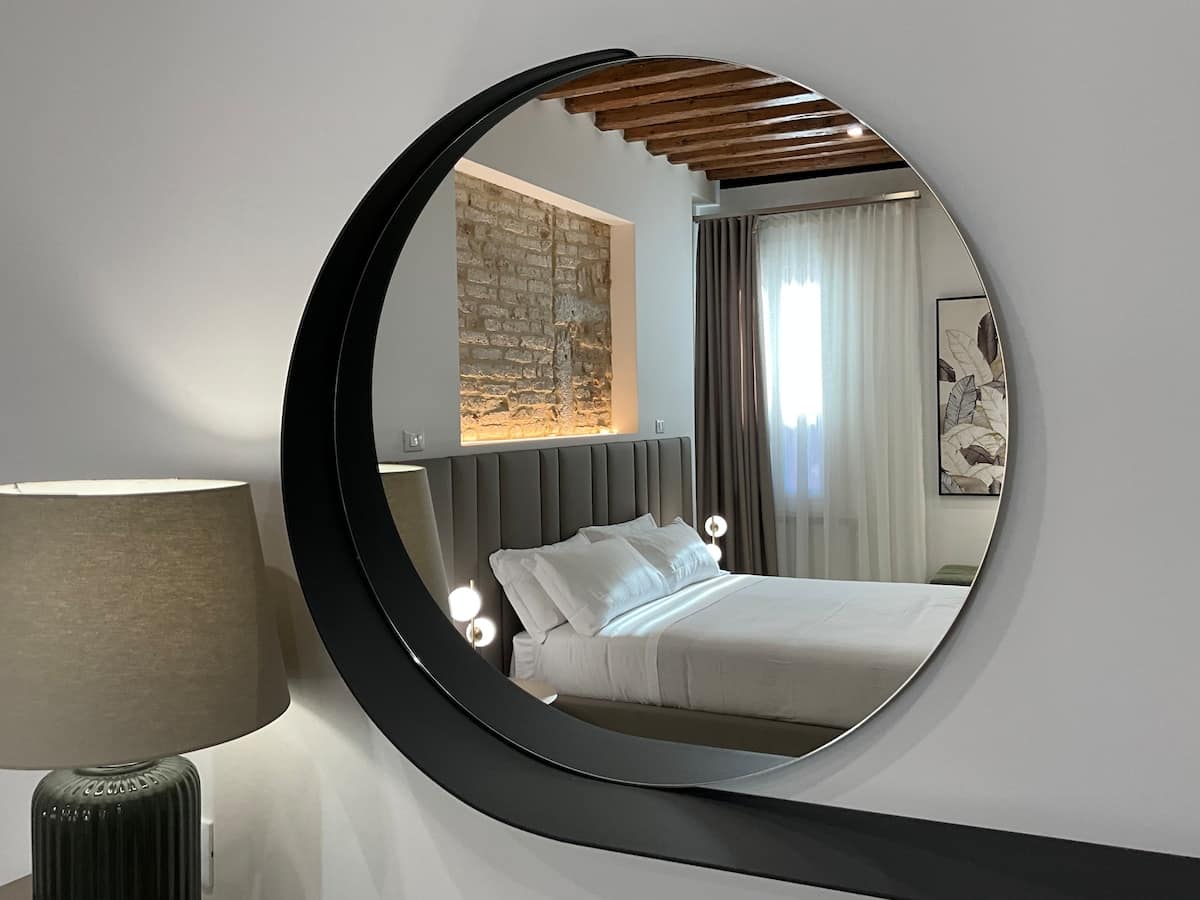
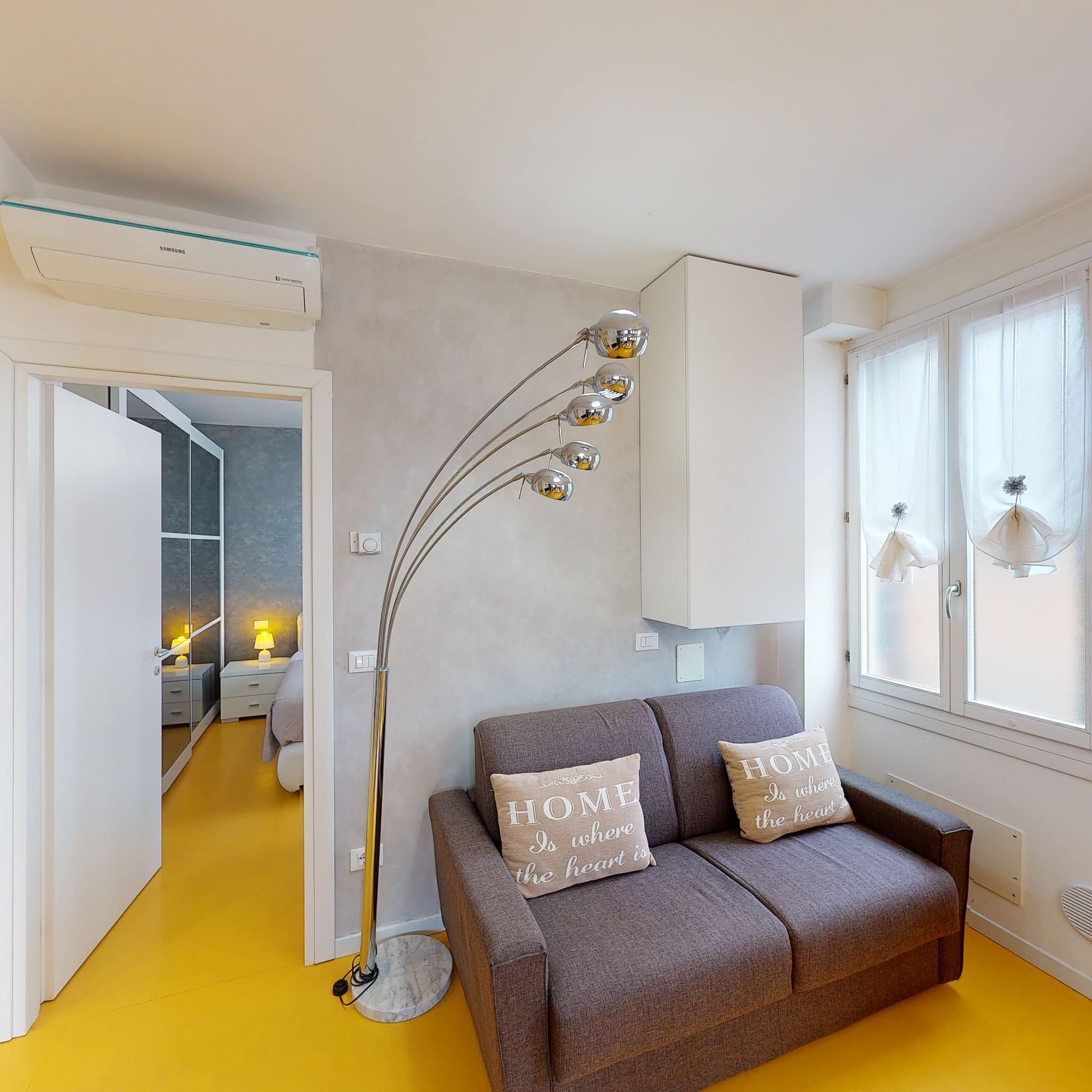
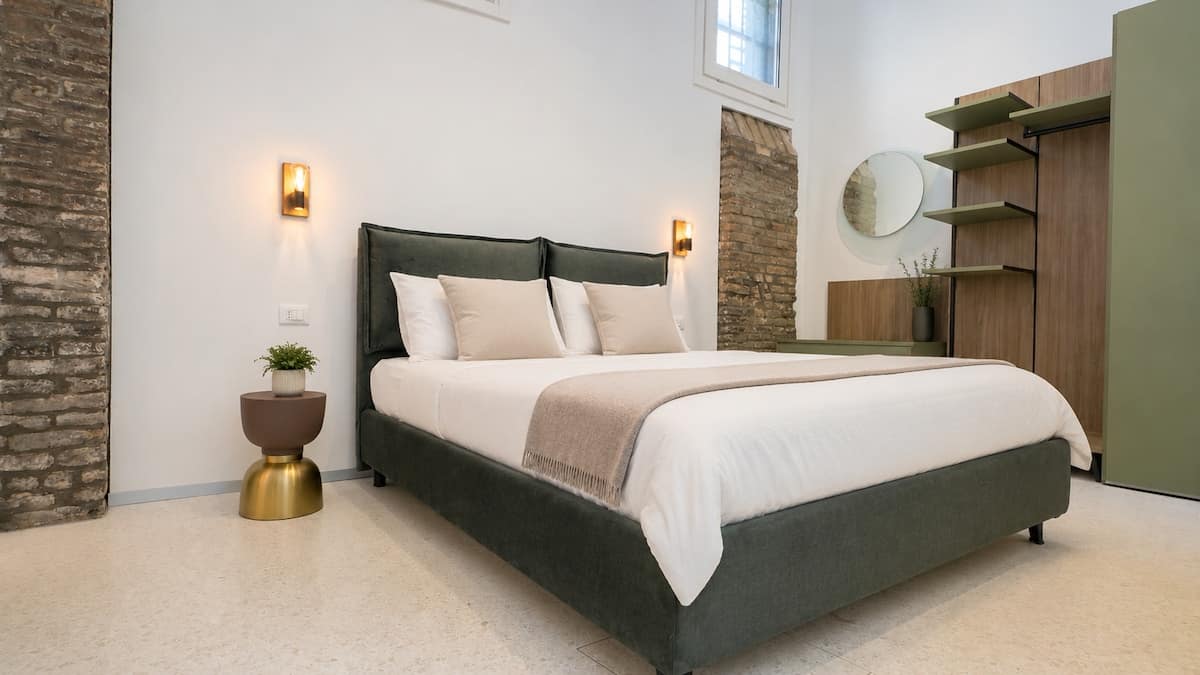
Furnishings vary. Venetian apartments range from carefully restored period flats to mid-range Italian-furnished units to modern conversions. The catalogue we host favours restraint, period bones, and good linen.
Where to look: the four central sestieri we host in
Venice is divided into six sestieri (the word means one-sixth). Five sit on the historic centre’s main islands; the sixth, Castello, extends east toward the Arsenale. Below is the practical view of the four where we host. For a deeper read on each, see the sestiere-by-sestiere pillar.
San Marco, the central choice
San Marco is the smallest sestiere and the busiest. It contains the Basilica di San Marco, the Palazzo Ducale, and the Mercerie, the historic shopping thread that runs from Rialto to the Piazza. The vaporetto stops at San Marco Vallaresso and San Zaccaria carry every major line, including the airport route via Alilaguna. Choose an apartment one calle off the main route; the difference between Mercerie and a parallel calle is the difference between two cities.
We host eight apartments here, including Cà Fortuny, a canal-side flat in a restored palazzo, and the Baretteri Romantic Flat, two minutes from the Piazza on a quiet calle. Read the San Marco sestiere guide for landmarks and places to eat.
Castello, for a quieter first stay or any second one
Castello is the largest sestiere by surface and the most residential. Walking east from the Piazza, the calli widen, the tourists thin, and Via Garibaldi opens with a morning market. The Biennale Giardini, where the art world meets every odd year and the architecture world every even one, sit at the far end.
We host seven apartments here, including Celestia Panoramic, a third-floor lagoon-facing flat with the vaporetto at the door, and Cà Lorenzo, a two-bedroom flat near Santa Maria Formosa. Read the Castello sestiere guide.
Cannaregio, where Venetians still live
Cannaregio is the northern sestiere, defined by three parallel canals and the long fondamente that run beside them. The afternoon sun arrives late and stays. The Venetian Ghetto, established in 1516 and the oldest in Europe, sits here. So does the densest concentration of bacari in the city, along the fondamenta della Misericordia.
We host Little Gem in Misericordia, a small flat on the fondamenta itself. Read the Cannaregio sestiere guide.
San Polo, by the market
San Polo holds the Rialto market, the Frari basilica, and one of the densest historic-restaurant maps in the city. We host one apartment here, a flat that faces the canal a minute from the bridge. Read the San Polo sestiere guide.
What to look for in a listing
Five things separate a clean listing from a misleading one.
Floor and lift. A second-floor walk-up is one thing; a fourth-floor walk-up with a heavy suitcase is another. The listing should state the floor and whether a lift is present. If it does not say, assume there is no lift.
Window orientation and view. A serious listing tells you what the windows face: the canal, the calle, a courtyard, the roofline. Photos from the windows looking outward are more useful than photos of the apartment looking inward.
Number of bathrooms. A family of four with one bathroom and a 06:30 vaporetto to catch is a different stay from a family of four with two bathrooms. Two bathrooms are not standard in Venetian apartments; the listing should be explicit.
Air conditioning. Venice is hot in July and August. Air conditioning is common but not universal in apartments above the piano nobile; older ceilings are tall and the heritage authority sometimes blocks the routing. Confirm before booking a summer stay.
The host’s response time. A serious operator responds within hours, in your language, with specific answers. A vague pre-booking response often predicts a vague check-in experience.
Each of these is surfaced on every apartment detail page on this site. If a listing elsewhere does not name them, ask.
Where not to stay
Three places get repeatedly listed as “Venice” by booking platforms and are not Venice.
Mestre. Mestre is the mainland suburb across the Ponte della Libertà bridge. It has cheaper hotels, mostly chain, mostly near the train and bus terminus. From Mestre to the historic centre is a 10-minute train or a 25-minute bus. It is not Venice. If you stay in Mestre, you wake in a city of cars and commute to the city you came to see.
The Lido. The Lido is the long sandbar across the lagoon that holds the Adriatic beaches. It is part of the municipality of Venice but practically separate; it has cars, hotels with parking, and a beach culture. A reasonable choice in August, the wrong choice for a first or short visit. From the Lido to San Marco is a 20-minute vaporetto, which sounds short until you do it twice a day.
Modern conversions on the mainland. Apartment platforms list flats in Mestre, Marghera, and along the railway line as “Venice apartments”. They are not. Read the address.
How long to rent for
Two nights is the minimum that makes the trip work. One night and you only see the surface, then climb back on a train tired. Three to four nights is the sweet spot. A week lets you settle into a sestiere, find a bar, and take a day to Burano or Torcello. Most apartments require a three-night minimum.
Our average stay is 4.6 nights. The pattern: arrive in the late afternoon, stay through two full days plus a half day, leave on the morning of the fourth or fifth day. The Practical Venice section on stay length covers the question in more depth.
Apartment vs hotel vs B&B
| Format | Best for | Watch for |
|---|---|---|
| Apartment | 2-7 nights, 2+ guests, design-aware travellers | Stairs, summer A/C, kitchen quality |
| Hotel | 1-2 nights, solo travel, traveller who wants a desk | Room size, courtyard rooms with no view |
| B&B | 2-3 nights, single travellers, light budget | Variable quality, fixed breakfast hours |
The honest summary: apartments win clearly above two nights and above two guests. Below those thresholds, a small hotel can be the simpler choice.
How direct booking compares with Airbnb or Booking
The apartments we host are also listed on Airbnb and Booking. Both platforms work; both add a commission of 14% to 22% to the nightly rate, shown to the guest as a service fee or absorbed into the displayed price.
Booking directly with us gives the same apartments without the platform commission. There is no concierge layer, no upsell. The booking is faster, the email arrives from the host, and the price is 5% to 10% lower than the same dates on Airbnb. Both paths exist on this site; pick whichever you prefer.
What we host, in one place
Apartments across four sestieri, hosted by Venetian hosts since 2014. 4.76★ on 1,000+ Airbnb reviews. Average stay 4.6 nights. The fastest path from this article to a real apartment is the full catalogue; the easiest read one level up is the where-to-stay pillar.