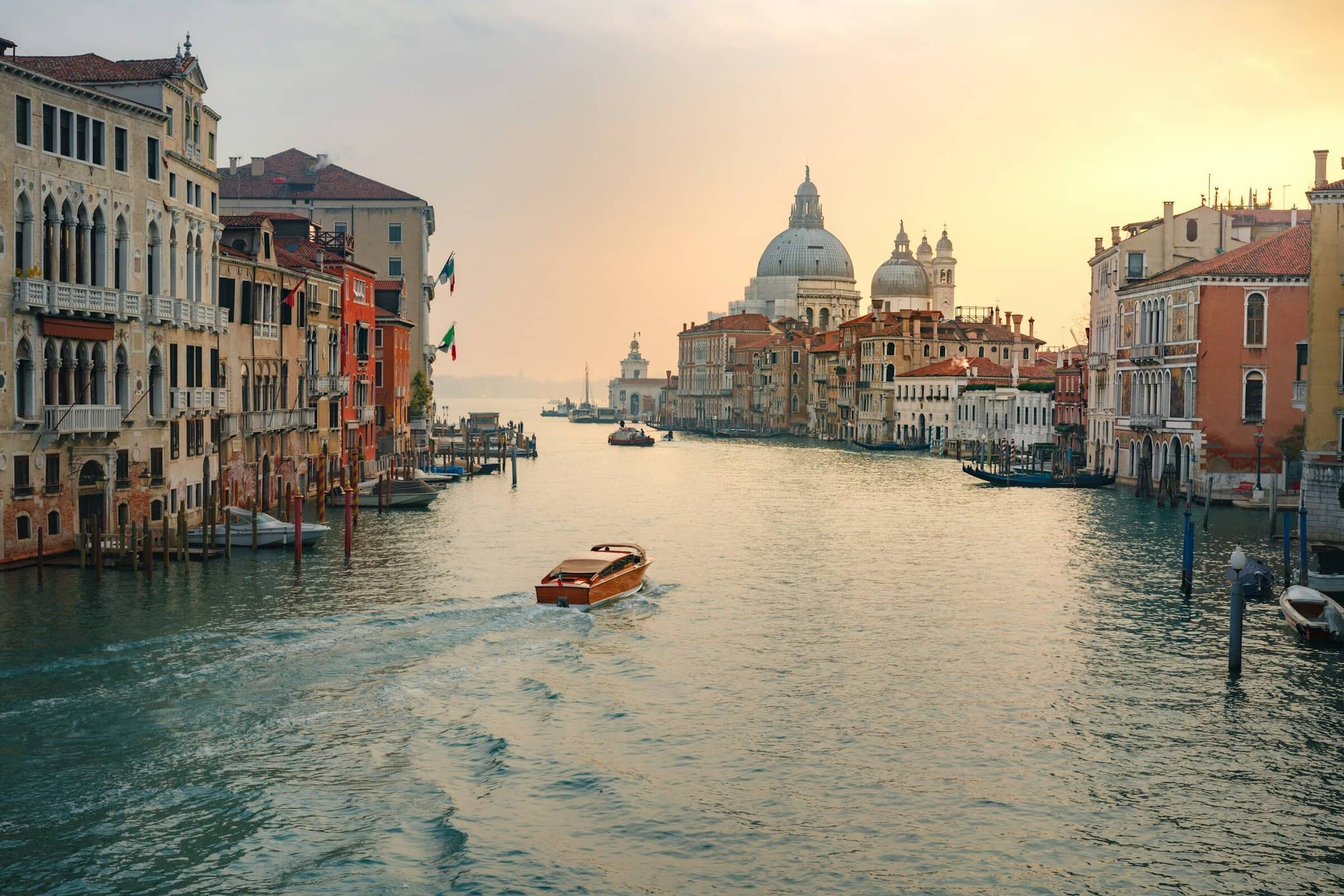
In August 2021 the Italian government imposed a ban on cruise ships above 25,000 gross tons entering the central waterways of Venice. The decree was the culmination of two decades of campaigning by Venetian residents, environmental groups, and UNESCO, and it reshaped one of the most contested visual relationships in European tourism: the mismatch between a 12th-century city built at the scale of a fishing village and 21st-century cruise ships built at the scale of skyscrapers. This article explains what the ban does, what it does not do, where the ships go now, and why this matters to a traveller arriving in Venice in 2026.
The short answer
Large cruise ships (over 25,000 gross tons) have been banned from the Bacino di San Marco, the San Marco Canal, and the Giudecca Canal since 1 August 2021. The same decree declared those waterways a national monument. Smaller ships still dock at the Marittima terminal on the western edge. Large ships are redirected to the industrial port of Marghera or skip Venice entirely. The total cruise passenger throughput is roughly one-third of the 2019 peak.
For the day-tripper context that the cruise ban also shapes, see The Venice Access Fee and Day Trip vs Overnight in Venice.
What the ban actually says
The legal instrument is Decreto Legge n. 103 of 20 July 2021, converted into Law n. 125 of 16 September 2021 by the Italian Parliament. Two clauses do the work.
Article 1.1. Vessels above 25,000 gross tons, or above 180 metres length, are prohibited from transiting through the Bacino di San Marco, the San Marco Canal, and the Giudecca Canal. The prohibition applies year-round, with no seasonal exception.
Article 1.2. The same waterways are declared national monuments under the Italian heritage code (Codice dei Beni Culturali). This legal status gives the protection a longer life than the immediate ban: it is much harder to repeal a national-monument designation than to amend a transport regulation.
The 25,000-ton threshold was a political compromise. The Venetian referendum that preceded the law (the 2021 referendum delle 14) asked for a stricter ban; the cruise industry pressed for a higher threshold or none at all. The 25,000-ton number broadly corresponds to the upper end of small expedition-style cruise ships and the lower end of mid-size mainstream cruise ships. The giants of 90,000 to 180,000 tons that had become Venice’s daily visual signature are firmly excluded.
The English-language legal summary is on the Library of Congress’s global legal monitor; the Italian original is on the Gazzetta Ufficiale archive under DL n. 103 of 20 July 2021.
What the ships used to look like
For two decades before the ban, the daily transit of cruise ships through the Bacino di San Marco was the most photographed contrast in European tourism. Ships of 90,000 to 140,000 gross tons (and a handful as large as 180,000) passed between Piazza San Marco and the island of Giudecca, in a channel where the buildings on either side rose to 12 to 25 metres tall. The ships, by contrast, rose to 55 to 70 metres above the waterline. They overtopped the Campanile of San Marco from the deck level alone; the bridges and observation balconies on the ship were higher than any monument in the city.
The peak year, 2019, saw 660 cruise ship dockings at Venice, carrying about 1.5 million passengers. Most ships docked at the Marittima terminal on the western edge of the city, having transited the bacino under tug guidance. The arrival was timed for the morning crowd: most passengers came ashore between 09:00 and 11:00 and re-embarked between 17:00 and 19:00, the same hours as the bus tour day-trippers.
The visual mismatch was extreme. The environmental impact was harder to quantify but consistently documented. The water displaced by a passing 140,000-ton ship is roughly equivalent to the displacement of a small dam break, sluicing through the canals and lapping the foundations of the palazzi. Repeated cycles, daily, over decades, are now understood to have accelerated the structural decay of buildings along the Giudecca canal.
What changed it
Two specific events forced the political decision after years of inaction.
The MSC Opera collision (2 June 2019). The 65,500-ton MSC Opera lost engine control while approaching the San Basilio terminal and collided with a smaller river-cruise vessel, River Countess. Four passengers were injured. The incident was filmed by hundreds of bystanders and circulated globally. The footage of a 13-deck cruise ship pressing into a pleasure craft at a city dock, against the backdrop of the Salute basilica, became the defining image of the case for the ban.
UNESCO’s threat to list Venice as ‘In Danger’ (2021). UNESCO had been pressing Italy for restrictions since 2014. In June 2021 the World Heritage Committee announced that without the ban Venice would be added to the In Danger list at the next session, a status that would have implications for Italy’s broader heritage management. The Italian government issued the decree six weeks later.
The 2021 ban was not the first attempt. A 2013 government decree had also banned ships over 96,000 tons but had been struck down by Italian administrative courts on environmental-procedure grounds. A 2015 decree was similarly blocked. A 2017 decree proposed rerouting ships through the Vittorio Emanuele canal, which would have required dredging that environmental groups successfully challenged. The 2021 decree learned from each: it bundled the ship-size limit with the national-monument designation, the dual basis was robust against challenges, and the route (to Marghera) used an existing industrial channel that did not require new dredging.
Where the ships go now
The 2021 ban was issued without a finished replacement port for the large ships. The interim solution: large ships are docked at the industrial port of Marghera, 15 kilometres west of the historic centre on the mainland, where commercial container shipping and the chemical works already operate. Passengers disembark at Marghera and are bussed across the lagoon causeway to Piazzale Roma at the western edge of Venice (a 20-minute journey).
The arrangement is imperfect on three counts. Marghera was not built for tourist passenger handling; the bus transfers are awkward; the Marghera waterway has its own environmental issues. The Italian government has been studying a longer-term solution involving a new dedicated cruise terminal at the lagoon mouth (Bocca di Lido) that would land passengers on a transport line into Venice; this remains under design as of 2026.
A second post-2021 effect: many cruise lines simply removed Venice from their itineraries or restructured to use Trieste (130 km east, on the Adriatic coast) or Ravenna (140 km south) as the docking port, with bus or train transfers into Venice. The total number of large-ship cruise passengers reaching Venice in 2025 was approximately 30 percent of the 2019 peak.
Smaller ships under 25,000 tons continue to use the Marittima terminal on the western edge of the city. These include expedition-style cruise vessels (50 to 250 passengers), small luxury cruises (up to 500 passengers), and river-cruise boats that operate up the inland Po and Sile rivers from Venice. The visual impact of these smaller vessels in the bacino is comparable to a large vaporetto, not to a floating apartment block.
Why it matters to a visitor
The cruise ban has reshaped the daily rhythm of central Venice in three specific ways that a 2026 traveller will notice.
The bacino di San Marco is open again. The view from the Riva degli Schiavoni, from the Punta della Dogana, from the Campanile, no longer includes the daily passing of giants. The lateral view of the Salute basilica, the long approach to the Lido, the open sky over the lagoon: all returned to the scale they were built at. The morning and evening light in the Piazza no longer competes with reflected ship hulls.
The daily peak load on the central calli has shifted. Before 2021, cruise ships brought a defined wave of 5,000 to 15,000 passengers ashore between 09:00 and 11:00, with another wave back at 17:00. Without those waves, the central crush of mid-morning is materially smaller, and the late-afternoon Piazza has more breathing room. The same hours are still busy with day-trippers from buses and trains, but the cruise spike that compounded those flows has flattened.
The case for staying overnight is stronger. The 2021 ban removed one type of day-tripper. The 2024 access fee began to discourage another (the bus and train day-tripper). Both shifts converge on the same conclusion: the city is repositioning itself around overnight stays. An overnight visitor in 2026 has a materially better Venice than an overnight visitor in 2019 had, simply because the bacino and the central calli are less saturated with the day-traffic that defined the 2010s.
For the decision on day-trip versus overnight in this new context, see Day Trip vs Overnight in Venice. For the access fee that complements the cruise ban as a tourism-flow tool, see The Venice Access Fee.
What the ban does not do
Three common misunderstandings.
It does not stop tourism. Venice received approximately 30 million visitor days in 2025, in line with 2019, but the composition shifted: fewer cruise passengers, more overnight guests, more bus day-trippers. The total volume is similar; the distribution is different.
It does not eliminate cruise tourism. Small ships under 25,000 tons continue to dock at Marittima. River cruises operate normally. The 2026 cruise traveller arriving on a 200-passenger expedition cruise has the same Venice docking experience as in 2019.
It does not solve the broader sustainability question. Venice’s central tension (a 50,000-resident city receiving 30 million visitor days a year) is not addressed by removing one source of those visitors. The city has been layering additional measures: the access fee (2024), the bus cap (since 2008), the planned tourist-reservation system for the busiest dates (under design). The cruise ban is one tool in a wider mix.
The broader policy context
The 2021 cruise ban is the most visible of three policy levers Venice has used in the last 15 years to manage tourism flows.
The 2008 tourist-bus cap. Daily limits on the number of tour buses that can park at Piazzale Roma, the road terminus. Drove a small reduction in bus-tour day visitors but pushed some volume to train day visitors.
The 2021 cruise ban. Removed the giants. Reduced peak loads at the bacino and on the central calli.
The 2024 access fee. Introduced a small fee for day visitors on listed peak days. See The Venice Access Fee for the 2026 rules.
The cumulative effect is the slow movement of Venice’s tourism economy from a day-tripper extraction model toward an overnight-stay model. Overnight guests pay the city tax, eat dinner, sleep, eat breakfast, and use the city in two-day rhythms rather than one-day rhythms. The economic case for the city is clear; the policy direction is set; the implementation is incremental.
What this means for your visit
For most travellers in 2026 the cruise ban is invisible, in the sense that the absence of giants in the bacino is the new normal. The ban shows up indirectly: in the relative calm of the late-afternoon Piazza, in the clarity of the view across the bacino to Giudecca, in the smaller queues at the Doge’s Palace on a weekday morning, in the slightly higher chance of getting a same-week reservation at a serious Castello trattoria.
The right traveller response is to stay overnight, ideally for three or more nights. Day-trip cost is now higher (the access fee on listed days), overnight cost is unchanged (the city tax has not changed since the ban), and the qualitative city experience between the two has widened in favour of overnight. This is the policy’s intent; it works as designed.
For the full overnight case, see Day Trip vs Overnight in Venice. For the sestiere choice for an overnight stay, Where to Stay in Venice. To choose a flat for the dates that interest you, the full apartment catalogue.
Authoritative external references: the Library of Congress’s English-language summary of the 2021 decree is the most accessible legal source; the Washington Post’s coverage from July 2021 covers the political context; the Wikipedia article on cruise tourism in Venice covers the longer chronology from the 2010s.