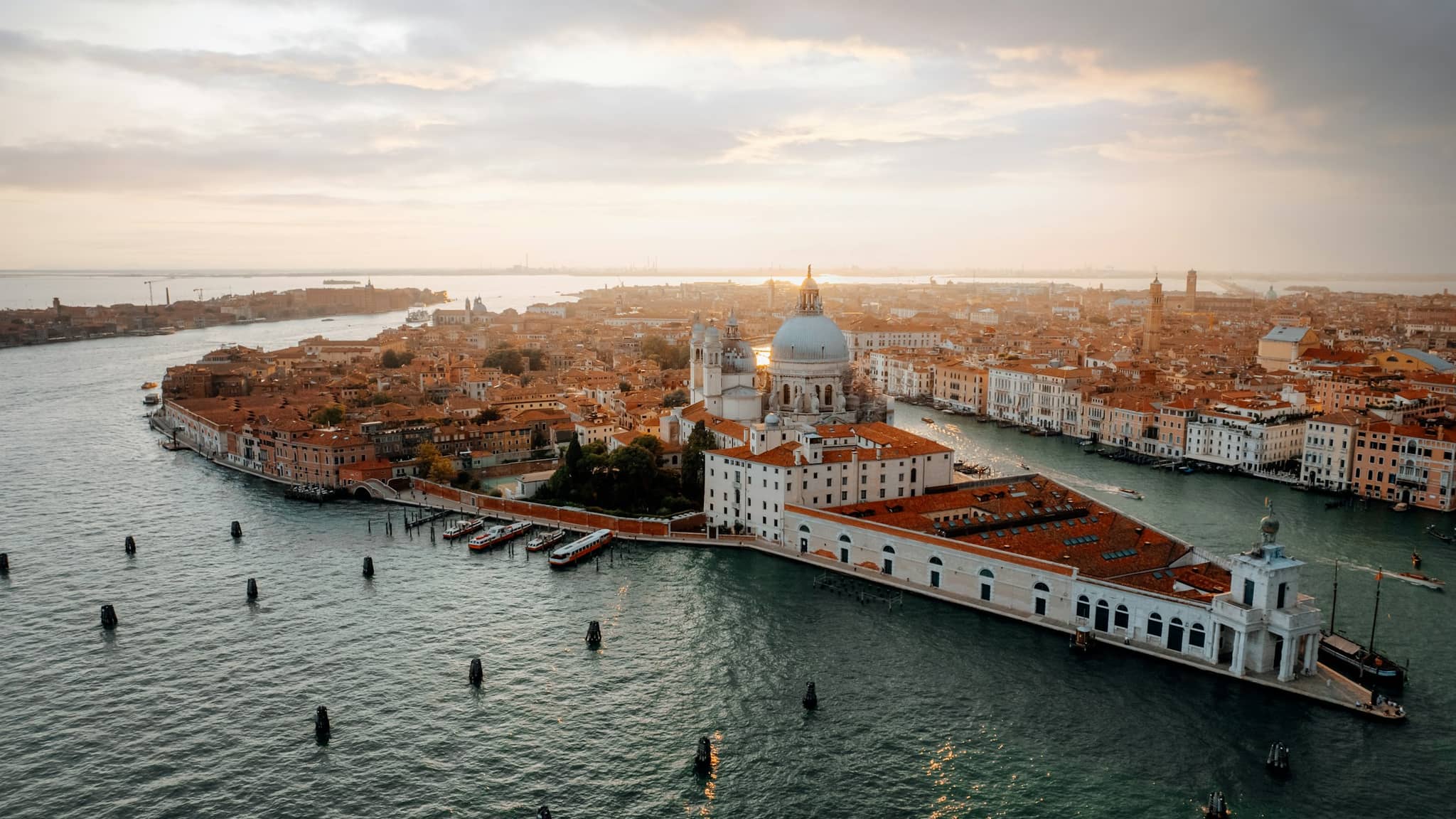
In 2024 the city of Venice introduced a paid-entry scheme for day-trippers, called the contributo di accesso or access fee. It is the first scheme of its kind in any major European city. After two pilot years, the rules for 2026 are now stable: a €5 to €10 charge for day-trippers entering the historic centre on 60 selected peak days, between 08:30 and 16:00, with broad exemptions for residents and overnight guests. This guide covers exactly what the fee is, when it applies, who pays, how to pay, and what happens if you don’t.
The short answer
The fee applies to day-trippers (aged 14 and over) entering the Venice historic centre on 60 listed peak days from 3 April to 26 July 2026, between 08:30 and 16:00. The cost is €5 if booked by the Wednesday before; €10 if booked from the Thursday onwards. Overnight guests (anyone with a hotel or apartment booking) are exempt for the entire stay. You register on the official portal at cda.ve.it.
If you are spending even one night in Venice, you do nothing: your accommodation handles the exemption automatically.
If you are a day-tripper on one of the listed dates, you pay €5 to €10 and download a QR code.
If your visit falls on a date that is not on the list, you do nothing.
What the fee is, and what it is not
The access fee is a paid-entry charge for day visitors, intended to slow the surge of cruise-passenger and bus-tour traffic that arrives at the city’s edges between 09:00 and 11:00 and leaves between 16:00 and 18:00. It is small in absolute terms (€5 to €10), but the act of registering, even when exempt, is the first piece of friction the city has ever imposed on day arrivals. The expectation, after three years of data, is that the registration step itself filters more visitors than the price.
The fee is not a tax. It is a contributo, a contribution toward the maintenance of the historic centre, paid into a municipal fund whose use is reported annually. The legal basis is a 2019 national law that authorises Venice (and any city of art) to charge for access; the implementing regulation has been refined each year since the 2024 trial.
The fee is also not a substitute for the city tourist tax (tassa di soggiorno), which overnight guests pay through their accommodation and which has existed since 2011. The two are deliberately separate: the access fee captures the day-tripper, the tourist tax captures the overnight visitor. We cover the overnight tax in the Venice City Tax guide.
When the fee applies in 2026
The full list of 60 dates is published on the official site. The pattern, for 2026:
- Every Friday, Saturday, and Sunday between 3 April and 26 July, inclusive.
- Easter Monday, 6 April.
- The entire week of 27 April to 3 May, which absorbs Liberation Day (25 April) and Labour Day (1 May).
- The entire week of 1 to 7 June, which absorbs Republic Day (2 June).
Active hours: 08:30 to 16:00. Outside the active window, entry is free even on listed days. Arriving at 16:30 on a Saturday, you do not pay.
Outside the 3 April to 26 July window, the fee does not apply at all in 2026. Visiting in March, August, September, or October, you do not pay regardless of the day of the week. This matters: half the high-season weeks are not subject to the fee at all. Compare your dates against the official 2026 calendar before assuming you have to register.
The cost: €5 versus €10
The fee has two tiers, set by booking time:
- €5 if you book by 23:59 on the Wednesday before your visit (so by Wednesday for a Friday-to-Sunday visit, or by the Wednesday before the listed dates in late April and early June).
- €10 if you book from the Thursday onwards, including the day of the visit.
The doubling is deliberate: the city wants planned visits, not last-minute arrivals. Cruise day-trippers, who often decide on their excursion the night before docking, pay the higher rate by default.
There are no discounts for groups, families, or repeated visits. The only reductions are the exemptions listed below.
Who is exempt
The exemption list is broad. In 2026 you do not pay the fee if you are:
- An overnight guest with any accommodation booking in the historic centre or its lagoon islands. Your stay covers the day of arrival, every full day of the stay, and the day of departure. Your accommodation handles the registration automatically through the regional tourist database; you do not register yourself.
- A child under 14. No registration needed.
- A resident of the Veneto region. Registration with proof of residence.
- Entering for work or study inside the historic centre, with documentation (a work contract, a university enrolment, a school visit).
- Entering for medical reasons (a hospital appointment, accompanying a patient), with documentation.
- A property owner in the historic centre, with documentation.
- A first-degree relative of a resident, with documentation.
- Visiting an art exhibition, conference, or cultural event with an official invitation.
The full list is on the Comune di Venezia access page. If you fit any of these and you are travelling during one of the active windows, you still need to register your exempt status on the portal in advance, even though you pay nothing. The portal issues a confirmation that you can show at a control.
How to pay
The fastest route is the official municipal portal at cda.ve.it. The steps:
- Open the site in any browser. It is available in English, Italian, French, German, Spanish, Chinese, and Russian.
- Select your arrival date.
- Declare your category: day-tripper (pay), or exempt (free with registration).
- Enter your name and email; for exempt categories, attach the relevant document.
- Pay €5 or €10 by credit card or PayPal, if applicable.
- Receive a QR code by email. Save it to your phone or print it.
The alternative payment route is in person at any Italian tobacconist (a tabaccaio) displaying the Punto LIS logo, which exists in every Italian town. You give the dates, pay cash, receive a printed QR. This is the route for travellers who prefer not to register online; the cost is the same.
The QR code is your proof. At random checkpoints (the train station, Piazzale Roma, the cruise terminal, the major vaporetto stops where day-tripper traffic concentrates), municipal stewards may ask to see it. The check takes 10 seconds.
You do not need the QR to enter on a non-fee day, or outside the 08:30 to 16:00 window, or if you are exempt and have registered.
The overnight loophole, which is not a loophole
The cleanest way to “avoid” the access fee is to spend one night in Venice. This is not a loophole. It is the explicit design of the regulation: the city wants overnight guests because they support the resident economy (dinner, breakfast, bacari, museums spread over two days) and because they pay the city tourist tax which funds the same municipal services. An overnight guest in a €120 apartment for one night pays roughly €3 of city tax for that night, gets an exemption from the access fee, has dinner in Venice, has breakfast in Venice, and contributes substantially more to the city than a day-tripper who pays €5, eats a sandwich at the station, and leaves at 18:00.
If you were already considering a day trip, the math for an overnight stay is now clearly favourable. The full analysis is in Day Trip vs Overnight in Venice.
Common mistakes
Assuming the fee applies on all weekends, all year. It does not. The 2026 window is 3 April to 26 July only. A weekend in September is free of the fee.
Assuming the fee applies all day on listed dates. It applies 08:30 to 16:00. Late-afternoon arrivals do not pay.
Assuming the fee covers the islands beyond the lagoon. It covers the historic centre (the six sestieri) and Murano, Burano, Torcello, Giudecca, and a few others. Mestre and the mainland are not in the perimeter at all.
Assuming children pay. Under 14: no.
Assuming the access fee is the same as the tourist tax. It is not. See the Venice City Tax guide for the overnight side.
Forgetting that the exemption requires registration, even when free. If you are a resident, a worker, or a parent of a young child, you still pre-register your status on the portal so the system can check your status if you are stopped.
Why the fee exists
The honest context: in 2024 Venice’s historic centre received an estimated 30 million day-trippers, against a resident population of around 50,000 in the central city. The peak Saturday in spring drew over 80,000 day visitors in a single afternoon, mostly cruise passengers and bus tours. The result, in any practical measure (vaporetto crush, queue times, water pressure at the city fountains, garbage collection cycles, the basic question of whether residents can cross a calle), is unsustainable.
The access fee is the first municipal policy lever to discriminate between day-trippers and overnight guests. The 2024 trial generated about €2.4 million; the 2025 expansion roughly €5 million. The 2026 calendar refines the targeting toward the peak Saturdays in spring and the early-summer holiday weeks. The fee is not the solution; it is a piece of the policy mix that also includes the 2021 cruise-ship ban from the bacino di San Marco, the daily tourist-bus cap into Piazzale Roma, and the MOSE barrier that protects the centre from acqua alta. The cumulative effect, year by year, is to move the city slightly back toward the residential rhythm that the day-trip economy has been corroding.
Authoritative external reference: the Comune di Venezia information page is the legal source and is updated every December for the following year; Rick Steves’s coverage is the most readable English-language summary for the traveller.
What this means for your visit
Three scenarios cover almost every reader.
You are spending at least one night in Venice. You do nothing. Your host registers your stay; the exemption is automatic for every day of your visit including arrival and departure. The QR is not required.
You are a day-tripper on a date outside the active window (anything in 2026 outside 3 April to 26 July, or any non-Friday/Saturday/Sunday, or any time after 16:00). You do nothing. Entry is free.
You are a day-tripper on a listed peak day, during active hours. You register on cda.ve.it by the Wednesday before for €5, or last-minute for €10. You save the QR to your phone. You may or may not be asked to show it.
For the broader practical context of a Venice visit (water, vaporetto, acqua alta, what to pack), the deep read is Practical Venice. If the access fee tips your decision toward an overnight stay (which it should), the full apartment catalogue is here.